


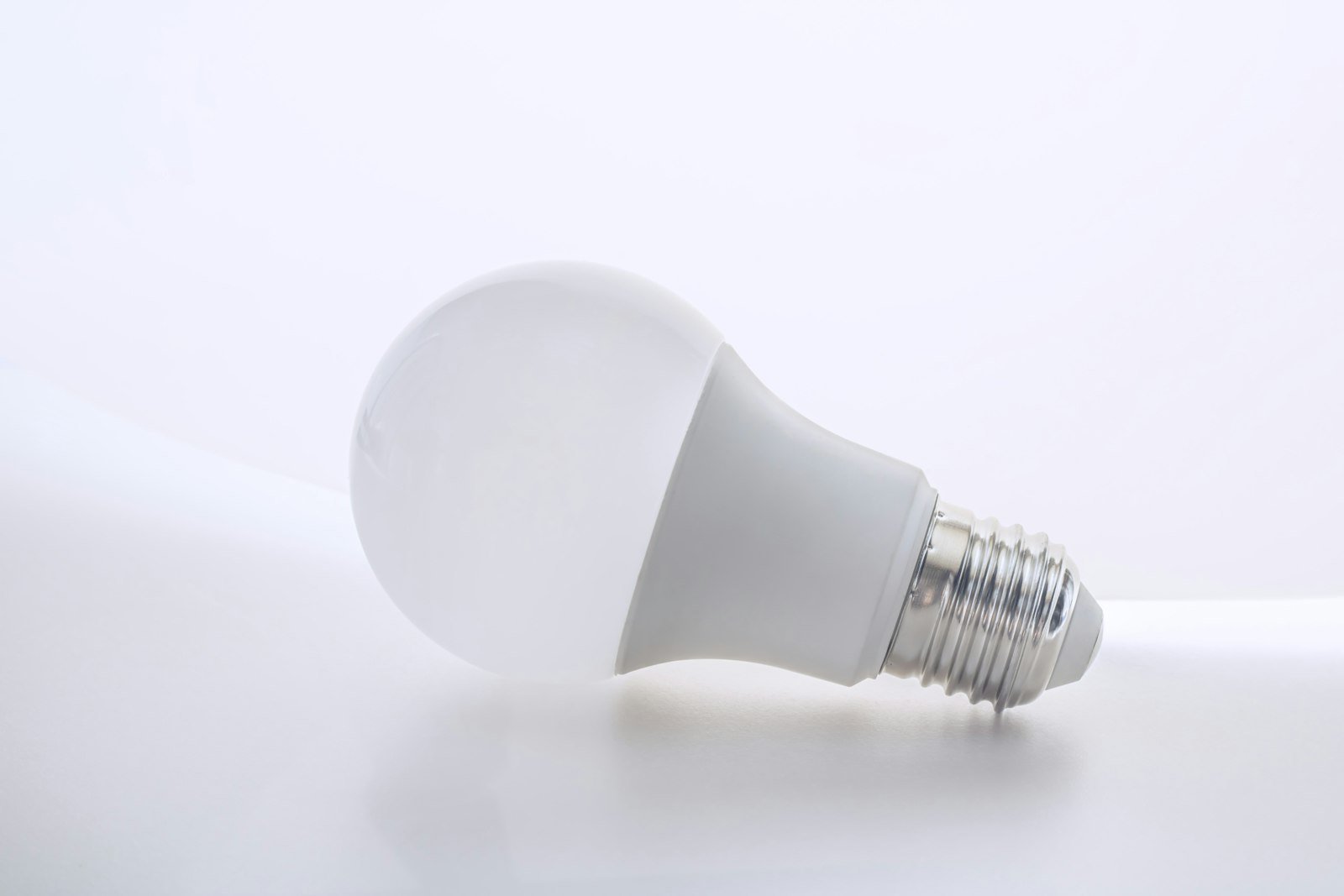
Energy saving light bulbs today means LED bulbs. They give the same light as old halogen bulbs for a fraction of the electricity and last many times longer. Older energy saving bulbs, the compact fluorescents or CFLs, have been phased out. To choose the right LED, look at lumens for brightness rather than watts, then at colour temperature and whether you need a dimmable bulb.
In short
| Question | Short answer |
|---|---|
| Which bulbs save most energy? | LEDs, by a wide margin |
| How much less than halogen? | About 80% less electricity, says the Energy Saving Trust |
| How long do they last? | Up to 20 times longer than halogen in many cases |
| How to judge brightness | Lumens (lm), not watts |
| Cosy light for living rooms | Warm white, around 2700 to 3000 K |
| Typical saving | £45 a year in Great Britain by replacing remaining halogen spotlights, per the Energy Saving Trust |
| Old CFLs | Contain a little mercury: take them to a recycling point |
Figures from the Energy Saving Trust’s lighting guide, updated on 19 November 2026 and consulted on 23 November 2026.
Why LEDs replaced the other bulbs
- Incandescent bulbs turn only about 5% of their electricity into visible light, according to the Energy Saving Trust; the rest is heat. Their sale has been banned in the UK.
- Halogen bulbs were a little better but have also been phased out. Many homes still have halogen spotlights in kitchens and bathrooms.
- CFLs, the first “energy saving bulbs”, took time to reach full brightness and contain mercury. They are being phased out too.
- LEDs turn on instantly at full brightness, fit almost every light fitting and, the Energy Saving Trust says, use about 80% less electricity than halogen bulbs for the same light.
Lumens, not watts
Watts measure how much electricity a bulb uses, not how bright it is. With LEDs, a bulb of a few watts can be as bright as an old 60 W bulb. Check the lumens on the packaging: the higher the number, the brighter the light.
If an LED looks too dim, it usually has too few lumens for the room, not a fault. When replacing a bulb, compare the lumens of the old and new ones where possible, or use the equivalence shown on the LED packaging.
Colour temperature and colour quality
The colour of the light is shown in kelvin (K):
- very warm white, about 2700 K: similar to old incandescent bulbs, suits living rooms and bedrooms;
- warm white, 2700 to 3000 K: a warm general light for most rooms;
- cool white, 4000 to 4500 K: a purer white, which may suit kitchens or bathrooms.
The colour rendering index (CRI) shows how naturally colours appear under the light. The Energy Saving Trust suggests a CRI of 80 or more for most household tasks.
Fittings and dimmers
Check the cap before buying: bayonet, Edison screw or push-fit pins for spotlights, each in several sizes. Taking the old bulb to the shop avoids mistakes.
Not every LED is dimmable, and old dimmer switches designed for halogen bulbs can make LEDs flicker or buzz. Buy bulbs marked dimmable and, if needed, have an electrician fit an LED-compatible dimmer.
How much can you save?
The Energy Saving Trust estimates that replacing the remaining halogen spotlights in a home with LEDs saves about £45 a year in Great Britain and £60 in Northern Ireland. Just switching lights off when leaving a room saves around £7 a year in Great Britain.
To work out the saving for one bulb, use your own unit rate:
watts saved ÷ 1000 × hours a year × price per kWh
Example, with illustrative assumptions: a 50 W halogen spotlight replaced by a 5 W LED, used 3 hours a day, at 25p per kWh. The LED saves 45 W, so 0.045 kW × 1,095 hours = about 49 kWh a year, or roughly £12 a year for that one bulb. A kitchen with six such spotlights would save about £74 a year. Replace 25p with the rate on your bill: see why your electricity bill is so high.
Bulbs used for a few minutes a day save much less, so start with the lights that are on longest.
Disposing of old bulbs
- CFLs and fluorescent tubes contain a small amount of mercury. Do not put them in household waste: take them to a household waste recycling centre or a shop that collects old bulbs.
- LED bulbs contain electronics and are also best recycled at a collection point.
- Old incandescent and halogen bulbs are not usually accepted for recycling: check your local council’s guidance.
If a CFL breaks, air the room, avoid using a vacuum cleaner, and collect the pieces carefully with card and damp paper towel.
More guides are in the Energy section.
