


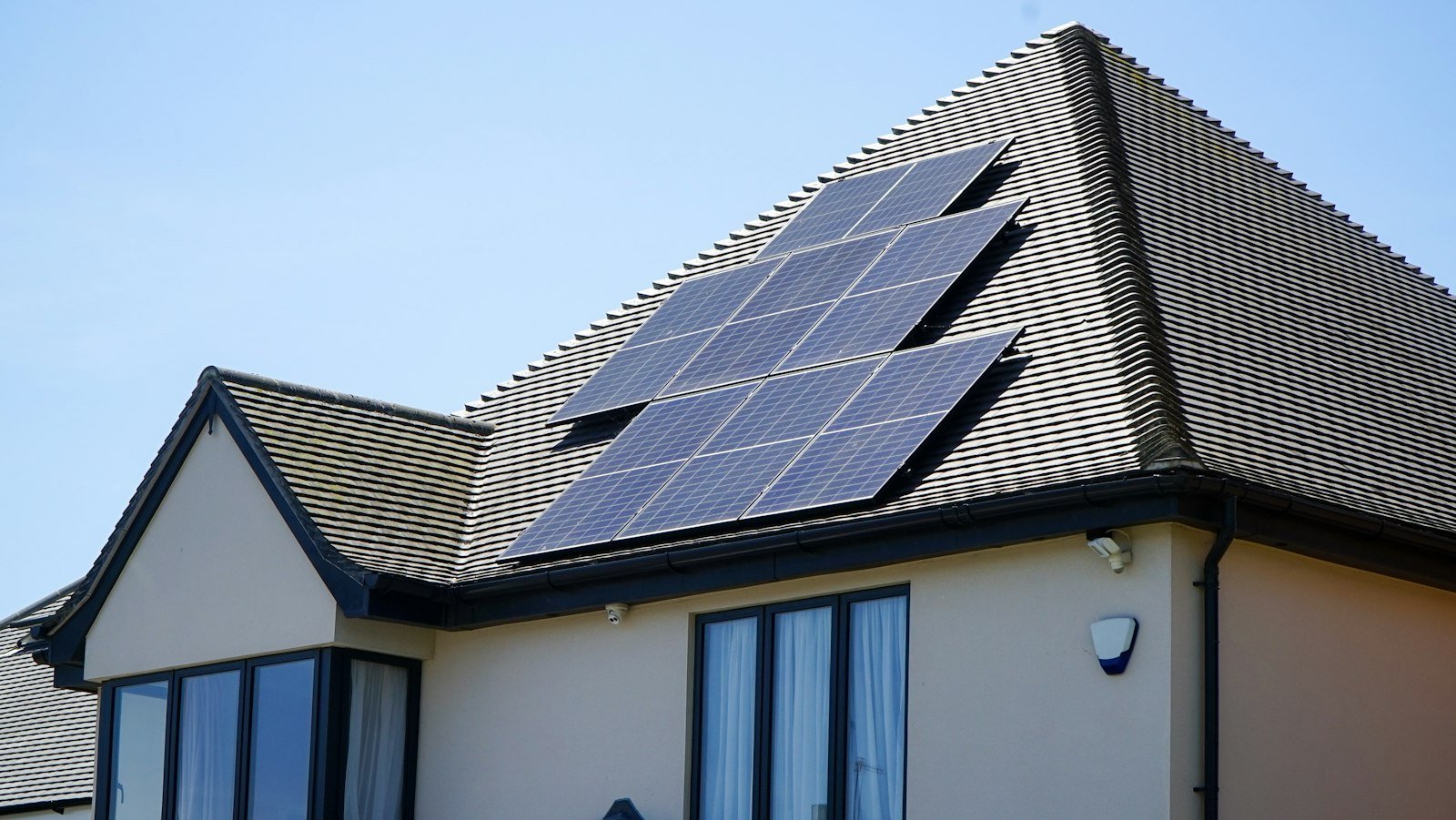
Solar battery storage lets you keep the electricity your panels make during the day and use it in the evening, instead of exporting it to the grid for a lower price. It can raise the share of your own solar power you use and cut what you buy. Whether it pays depends on three things: how much surplus your panels produce, how much you use after dark, and the gap between what you pay for electricity and what you are paid to export it.
In short
| Question | Short answer |
|---|---|
| What it does | Stores surplus solar electricity, or cheap off-peak electricity, for later use |
| Typical size | Around 5 to 10 kWh for a home; the Energy Saving Trust cites 10 kWh as typical |
| How to size it | From your evening and night use, not from the size of your panels alone |
| Usable capacity | Less than the label: most batteries keep a reserve and lose some energy charging |
| Lifespan | About 10 to 15 years, shorter than the panels |
| VAT | 0% since 1 February 2024, set to rise to 20% from 1 April 2027, according to MoneySavingExpert |
| Does it pay? | Sometimes; payback on solar savings alone can be long, so check your own numbers |
Figures checked against Energy Saving Trust and MoneySavingExpert guidance (updated 1 October 2026), as of 15 November 2026.
How a home battery works
Solar panels produce most around midday, when many homes use little. Without a battery, the surplus goes to the grid. With one, it charges the battery first, and only exports once the battery is full.
In the evening, the battery supplies the house until it reaches a set minimum level, often around 20% according to the Energy Saving Trust, then the home draws from the grid again. The system manages this automatically.
A battery can also charge from the grid at night on a time-of-use tariff, when electricity is cheaper, and run the house during the expensive peak. The Energy Saving Trust notes that a battery can save more when it runs a heat pump on such a tariff than when it only stores surplus solar. You don’t need panels to do this.
How to size a solar battery
Start from your evening use
The useful size is roughly what you use between sunset and the next morning’s solar production, on days when your panels produce a surplus. A larger battery that never fills, or never empties, adds cost without adding savings.
- Look at your half-hourly use on your smart meter data or supplier app, for a typical spring or autumn day.
- Add up use from early evening to morning. That is your target, before losses.
- Check your surplus. On a sunny day, how much do your panels export? A battery can’t store more than that.
- Take the smaller of the two. That’s the energy you can realistically shift each day.
MoneySavingExpert notes, as a rough guide, that a solar array can generate about double its peak size in kWh on a good day: a 4 kWp system could produce around 8 kWh, weather permitting. In winter it will be much less, so a battery sized for summer surplus will often sit partly empty from November to February.
Usable capacity
The capacity on the label is not all available. Most batteries are not fully discharged, to protect their life: MoneySavingExpert gives a usable share of 85 to 95% for most modern batteries. Some energy is also lost when charging and discharging, which the Energy Saving Trust points out makes stored energy less efficient than using solar power directly.
Example: if you use about 6 kWh in the evening and your panels export at least that on sunny days, a battery with around 7 kWh usable, so roughly 8 kWh on the label, would cover most of it.
Choosing a battery
- Chemistry: most home batteries are lithium-ion; many now use lithium iron phosphate (LFP), valued for its cycle life and thermal stability.
- AC or DC coupled: an AC-coupled battery has its own inverter and suits adding storage to an existing system. A DC-coupled or hybrid system shares one inverter with the panels and suits new installations.
- Expandable: some systems let you add modules later.
- Warranty: check its length, the number of cycles or energy throughput covered, and the capacity guaranteed at the end.
- Location: garage, utility room or external wall. Batteries dislike heat and work less well in the cold; follow the manufacturer’s guidance and keep them away from escape routes.
Use an installer certified by the Microgeneration Certification Scheme (MCS) and get at least three quotes, as the Energy Saving Trust advises. MCS certification matters if you want to sell exported power under the Smart Export Guarantee.
Does solar battery storage pay?
The saving per kWh stored is the difference between the price you avoid buying it at and the export payment you give up. If you pay 25p per kWh and are paid 15p to export, each stored kWh used later saves about 10p, before losses. These figures are only an illustration: use your own tariff.
The annual saving is then roughly:
usable kWh shifted per day × days with a surplus × saving per kWh × efficiency
MoneySavingExpert’s own modelling, using the October 2026 price cap and a 15p export rate, finds that savings from storing solar alone are often around £100 a year for typical homes, giving long payback periods for a battery costing several thousand pounds. The picture improves if you also:
- charge at night on a cheap time-of-use tariff and avoid peak rates;
- run a heat pump or charge an electric car from the battery;
- buy the battery with the panels, which usually cuts installation costs.
The Energy Saving Trust estimates the typical cost of a 5 kWh battery system at around £4,600, within a range of £1,500 to £10,000. Ask for quotes and run the numbers before deciding.
Other things to weigh
- Replacement: the battery will likely need replacing at least once during the life of the panels.
- Export tariffs: some export tariffs pay more at peak times, which can make exporting better than storing at certain hours.
- Feed-in Tariff homes: if you receive Feed-in Tariff payments, Ofgem advises contacting your supplier before adding a battery.
- Power cuts: many batteries do not power the home during a grid outage unless they have a backup or islanding function. Ask if that matters to you.
For the rest of an energy-efficient home, see how does a heat pump work and loft insulation. More guides are in the Energy section.
